
ON THIS DAY IN HISTORY
Dec. 30, 1922: Jane Langton born.
 |
| Francis Levy, photo by Hallie Cohen |


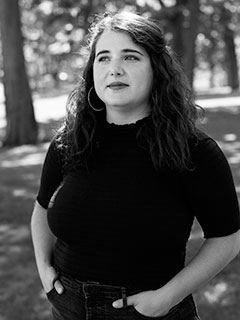
Elly Fishman is the author of the new book Refugee High: Coming of Age in America. It focuses on Chicago's Roger C. Sullivan High School. Fishman worked as a senior editor and writer at Chicago magazine, and now teaches in the Journalism Department of the University of Wisconsin, Milwaukee. She lives in Milwaukee.
Q: You note that you were inspired to write about immigrant and refugee life in Chicago following protests in 2017 about Trump's immigration and refugee policies. What led you to Sullivan High School?
A: I had been reporting out of Chicago for a number of years at that point and had written about different schools. I called my network and asked around where refugee and immigrant kids went to school.
I realized Rogers Park was the landing point for so many refugees in the city. Sullivan was their neighborhood school.
I was encouraged to reach out to [principal] Chad Adams; our mutual contact knew him and said he probably would be open to a story at Sullivan.
Q: How did you choose the students on whom you focused in the book, and what do they think of it?
A: I purposefully took my time choosing the students. I wanted to make sure I had several conversations before diving into a multi-year project.
I had done a magazine piece, “Welcome to Refugee High,” and when I came back, a number of kids knew me and introduced me to their friends.
I spent time in the library getting to know the kids and seeing who seemed interested. I also wanted to choose kids with different backgrounds. The resettlement process is so diverse; I wanted windows into different elements, and that their on-the-ground day-to-day experiences would be different enough.
I did use translators, but I didn’t want four translators in school with me every day, so I needed to find kids I could talk to and kids I connected to. We needed to spend a lot of time together.
I tried to stay in touch. Covid has made it hard. [Before that,] I knew if they ignored me for a few days, I could find them in class.
Some have read the book—I tried to get it to all of them. The reactions were really positive in some cases. Some were excited to have their stories out there to help other refugees.

For others, it was more challenging to see their stories on the page. This always comes up when you’re reading someone’s version of you. I encouraged the kids to ask me questions and feel they had agency, but at the end of the day, it’s my version of the story.
Q: What impact did writing this book have on you?
A: So much! Three to four years is a long time. I grew up in Hyde Park, and had written about young people—homeless youth, queer youth—but I had never immersed myself in the refugee experience. I feel I got a global education. I felt like it made me a more empathetic person, a better neighbor. This took me to new places I hadn’t been.
Q: And what do you hope readers take away from it?
A: The reason I chose to write the book through an intimate close lens of young people’s experiences is that this is a narrative we can take to heart.
So much of the refugee issue involves numbers, the big picture—but it’s important to look at life on the ground. It moved me, and I hope it moves readers to be more empathetic and eager to reach out to people in their own communities.
Q: What do you see looking ahead when it comes to immigrants and refugees in the United States?
A: There’s a lot of hope right now after three years of a pretty bleak landscape. I’m so moved by the incredible enthusiasm for helping resettle Afghan refugees in particular. I’m eagerly awaiting the arrival of Afghan refugees in Chicago.
There also are evergreen inherent challenges in finding your path. It’s a different administration but the anti-immigrant rhetoric has not gone away. It’s a continuing challenge. It’s coming up in elections all over Europe.
Refugee crises are not going to end, especially with global warming and political changes. It’s a mix.
Q: What are you working on now?
A: I’m not working on another book yet. I’m hoping to continue to tell more of these stories now that more refugees are entering the country.
I’m thinking about other issues that have emerged as I reported the book and we’re still navigating the pandemic. There are big ideas, but I need to find the story. I’m hoping to send time on the ground doing reporting and see what comes next.
Q: Anything else we should know?
A: Another reason I decided to focus on young people and what their lives looked like was because when I first walked into Sullivan, it was a dynamic, exciting high school with all the elements of high school—flirting, cafeteria cliques, texting.
It upended my image of refugee experiences—images of families fleeing to safety, refugee camps. Those are important, but this complicated that. It humanized the experience. They’re teenagers. There was so much that felt familiar to me. It felt like an important part of the story to highlight.
It shows kids’ resilience—they’re not only defined by the moments of trauma they carry. I wanted to put resilience front and center.
--Interview with Deborah Kalb
 |
| Photo by Christopher Michel |
Counting down the top 10 most-viewed posts of 2022...here's #5, a Q&A with Katie Hafner first posted Aug. 1.
Katie Hafner is the author of the new novel The Boys. Her other books include Mother Daughter Me. Her work has appeared in a variety of publications, including The New York Times and Esquire. She lives in San Francisco.
Q: What inspired you to write The Boys, and how did you create your character Ethan?
A: In the summer of 2017, I was on a bike trip in Scandinavia with my daughter. It was one of those trips where they take your luggage from one destination to the next, and you stay in really nice hotels and eat delicious food.
During one of those delicious meals, one of the guides told a story that I found intriguing, and so did my daughter, because she said, “Mom, that’s a novel.” And so I wrote it. I knew only the barest of facts and let my imagination take it from there.
I knew I wanted the main character to be a man -- an anxious man who hasn’t integrated very successfully with the outside world. Then I just let him develop from there.
Q: The writer Laura Zigman said of the book, “Hafner is a wry and wise explorer of the secrets buried deep in our most intimate relationships.” What do you think of that description, and how would you describe the relationships in the novel?
A: One of my main goals was to get the reader to connect with the characters by watching the characters connect with one another. I also wanted all the relationships in the book to originate with Ethan, in a hub-and-spokes way.
So, I created relationships for him that would help him connect to the wider world, the most important being with Barb, his wife, who's empathic and outgoing. She becomes Ethan's sturdiest spoke. It's Barb who shows Ethan that intimacy and connection needn't be dangerous, and can be wonderful and rewarding.

That central Ethan-Barb relationship plants the seeds for more connection in Ethan's life. Tragically, so deep is Ethan's bond with the two boys he and Barb foster that he drives Barb away. And yet....
Q: Did you know how the book would end before you started writing it, or did you make many changes along the way?
A: I knew generally how it would end but I got stuck on just how to pull it off. There had to be a plausible ending, and filling in the gaps with just the right particulars was a challenge. I hope you think it works!
Q: The novel is set in the Philadelphia area, and also in Italy. How important is setting to you in your writing?
A: Setting is super important to me. I chose Philly because I wanted an East Coast location, and although I’m not from Philly, my husband went to undergrad and medical school there, and when I was working on the book my daughter was living there.
There’s a key role played by the Mütter Museum in Philly, which was another reason to set it there.
I also wanted to find just the right house for Ethan and Barb to live in, and I found it in west Philly. My husband and I were admiring the house from the outside one day when the owners came walking up the street, and they gave us a tour.
Italy is important as a setting because it’s such a magical place: the hills, the villages, and the little churches everywhere. So I set Ethan and Barb’s honeymoon there in the first half of the book, then had Ethan repeat the trip with the boys, as he tries to recapture the magic.
Q: What are you working on now?
A: A few things:
I’m getting back to a book I started in 2015, which has a story I really love. It’s a low-key (no one is threatening to blow up the world) science thriller. But the plot is very intricate, the story multi-layered.
When I started that book, I realized it was a lot to take on as a first novel, so when the plot for The Boys fell into my lap, with a much cleaner narrative line, I put the first book aside. I think I’m ready now to take it on.
I’m also very busy with the podcast I produce, Lost Women of Science, which we publish in partnership with Scientific American.
And I’m working on a collection of essays about taking up the game of golf later in life in order to spend more time with my husband. Strange, I know.
--Interview with Deborah Kalb. Here's a previous Q&A with Katie Hafner.

Elinor Lipman is the author of the new novel Ms. Demeanor. Her many other novels include Rachel to the Rescue. She has taught writing at Simmons, Smith, and Hampshire colleges, and she lives in Manhattan and in Holmes, New York.
Q: What inspired you to write Ms. Demeanor, and how did you create your character Jane?
A: I create all my characters one sentence at a time. I rarely begin with an inspiration or even with a story to tell, and I know almost nothing about my characters until they reveal themselves. I’m always thinking what’s next? What makes sense? What makes a story? I’m a stern editor of my own work and can sense when I’m going down the wrong path. I do a lot of cutting--whole chapters.
I was once collecting advice for my students at a summer workshop, asking other members of the faculty, “What do you do when you’re stuck?” The author Carol Edgarian’s answer was, “Go back to the truest line.” I follow that almost daily. And I also follow David Mamet’s practice: Get into a scene as late as possible and leave it as early as possible.
Q: The author Wally Lamb said of the book, “Lipman, a master chef of literary romantic comedy, cooks up a deliciously entertaining story whose ingredients include wit, sass, sex, and social satire.” What do you think of that description, and would you describe your work as satirical?
A: What do I think of that description? I love it. I think there’s a difference between social satire and being satirical. The former can be gentler. I don’t let social satire invade the novel’s entire voice; it’s more in the characters’ individual observations.
Q: How would you describe the dynamic between Jane and her twin sister, Jackleen?

A: Both Jane and Jackleen see Jackleen as the alpha twin. She’s bossy and quite often condescending. Most of the time, Jane remains indulgent of Jackleen’s patronizing because it’s partnered with generosity and love. Jackleen means well. I think we all have a Jackleen in our lives. And I made sure to give Jane her due.
Q: You dedicated the novel to the memory of your friend, the wonderful writer Mameve Medwed. Can you tell us more about her?
A: She was my best friend for over 30 years, and though she’s only been gone a year, my brain is still wired to want to share with her every thought that runs through my head.
For decades I sent her everything I wrote for her feedback—every novel chapter as I polished them; every book review, every essay, every blurb I was asked to write. And vice versa. We were each other’s first readers, unofficial editors and cheerleaders. Her six novels are funny, sweet, poignant, smart. I wrote about the friendship here.
When people ask “Who do you write for? Who is your audience?” the truthful answer was “Mameve.”
Q: What are you working on now?
A: I’m on the third chapter of a novel that I’d better not characterize, because I recently threw away 30 pages of what I thought was the next novel when it went aground.
But here’s a hint: I did crowd-source one element of the new pages on Facebook: I asked my FB friends help in naming a fictional business that ran estate sales…
Q: Anything else we should know?
A: Sheltering during Covid wasn’t exactly house arrest, but it did provide some parallels. Like Jane, I went nowhere, did an awful lot of cooking, and binged on British Police Procedurals. The pandemic isn’t mentioned in the book. My editor thought it best to keep the story timeless.
--Interview with Deborah Kalb. Here's a previous Q&A with Elinor Lipman.


