Monday, June 5, 2017

Q&A with Ruth Freeman


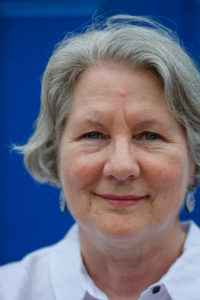
Ruth Freeman, photo by Molly Haley
Ruth Freeman is the author of One Good Thing About America, a new novel for kids. Her other books include Underwear and How Sweet It Is (and Was): The History of Candy. She lives in Maine, and she teaches students who are English language learners.

Q: How did you come up with the idea for One Good Thing About America and your main character, Anaïs?

A: I teach English language learners (ELL) in an elementary school in southern Maine, so I spend every day with wonderful students who inspired my story. The idea for a “school” story had been rolling around in my head ever since I went back to graduate school for a teaching degree, but it was when I started working with ELLs that I began to see “school” through their eyes.

Some of my students are brand-new newcomers, others were born here but speak another language at home. Because it takes approximately five to seven years to become fluent in both basic and academic English, we will usually work with the same students over several years, and thus get to know them really well.

We get to hear their stories, meet their families and answer their many, many questions because America is so confusing! Or, as Anaïs puts it, “crazy!”

Being a writer, I wanted to record the stories I was seeing and hearing everyday. What do you do if you don’t understand a word your teacher is saying, no one can pronounce your name, and the lunch choice is chicken fingers?
 

Anaïs is a blend of several of my students. I wanted to show how determined many of our ELL students are. They want to learn English, they want to do well in school, they want to make sense of the American culture. This is after they have left behind homes and friends and family members. They are an inspiration and I wanted others to meet them.

Q: Why did you decide to tell the story in the form of letters from Anaïs to her grandmother?

A: A couple of years ago I was working with some ELL students in a second grade classroom where they were writing persuasive letters, stating an opinion and trying to persuade others to their point of view.

I think that was the first time the letter-writing piece might have occurred to me. I had never written anything in letters before, but when it came time to tell Anaïs’ story I wanted the reader to be as close to her as possible, to see things from her point of view.

To keep it as realistic as possible, I thought she would write letters home to the grandmother she loves and misses in the Democratic Republic of Congo.

As I started writing the letters, I quickly realized what an interesting challenge it was going to be. Anaïs, even though she was the best student in English at her school back home, discovers she doesn’t know as much English as she thought.

By writing from her point of view, I had to see everything as she would see it. I limited myself to her vocabulary, her grammar and her spelling. I wanted to make the letters as authentic as possible, so I decided to use some spelling mistakes to show how a newcomer would hear the words.

For example, “know” becomes “no,” and “asked” becomes “askt.” As Anaïs learns more English, I had her vocabulary expand, and her grammar and spelling improve.

Q: How was the book’s title chosen, and what does it signify for you?

A: I have to thank my wonderful editor at Holiday House, Mary Cash, for the title. I’d been using a working title, knowing it might change. It was Mary who, after reading the manuscript many times, suggested One Good Thing About America, which was perfect! She emailed me that the title had been right in front of us all the time, and she was right.

The theme of one-good-things appears throughout the book, from when Anaïs’ grandmother first urges her to find good things about America, to the end when Anaïs’ friends and teachers tell her she is one good thing about America.

For me, the title signifies two things. First, I believe the people who are recent arrivals to this country, just as those who arrived years or generations ago, are without a doubt good things about and for America.

We are, after all, a nation of immigrants. New arrivals bring new ideas, new ambitions and new dreams and we are all the richer for it. The state where I live, Maine, has one of the oldest average ages in the country. Like many other parts of the country, we need immigrants to fill jobs and start new businesses.

Secondly, I like the title because it reminds me, and hopefully all readers, about the good things that are all around us if we look for them. When I was writing the book, I made a list of Anaïs’ one-good-things and my one-good-things.

Of course, many of her favorites are mine, too, like the library and sledding and ice cream! But my one-good-things also include spring peepers, sunsets and the sound of a car going by at night on a rainy city street. We all need to find those things that make us happy.

Q: As you’ve mentioned, the book focuses on a girl who comes to the U.S. from the Democratic Republic of Congo. Given the current attention on immigration issues, can you say more about what you hope readers take away from your book?


A: Some of my answer is up above in question #3 when I wrote about the title and how I think immigrants are good for America. In addition, I would say that it seems to make all the difference when we meet someone outside of our own circle and get to know them.

Learning about someone’s different background or different interests helps us gain a new understanding and empathy for them. Our horizon grows wider and richer for the experience. I love meeting new people and learning about them. Even when I meet someone I don’t agree with, it’s interesting to find out what makes them tick.

So, I hope readers of One Good Thing About America will get a glimpse of what life is like for a newcomer and, in so doing, come to understand and empathize with people who are new to this country.

Q: What are you working on now?

A: Whenever I finish a book, I never know if I will get another idea or not. Ideas come and go, but every now and then, one sticks and won’t go away. I love it when this happens!

I got an idea about a year ago for a new story. It’s been sticking in my head ever since. It’s in what I call the “jelly stage,” a lovely fluid stage where it grows and changes.

I’ve been so busy with One Good Thing About America that I haven’t worked on it besides doing some research and writing down some notes. It will be a novel for the same age group (ages 8-12).

Immigration will play a role, but won’t be as much of a focus as it was with Anaïs’ story. I’m hoping to use this summer, when I’m off from teaching, to dive in and start putting it on paper.

--Interview with Deborah Kalb

June 5

ON THIS DAY IN HISTORY
June 5, 1919: Richard Scarry born.

Sunday, June 4, 2017

Q&A with Beverley Naidoo


Beverley Naidoo, photo by Linda Brownlee
Beverley Naidoo's many books include the classic No Turning Back, about a boy living on the streets of South Africa, which was recently rereleased. Among her other works are Who Is King?, Journey to Jo'burg and S is for South Africa. She grew up in South Africa and is based in the U.K.

Q: How did it happen that No Turning Back was recently rereleased?

A: In 2001, the year in which I received the Carnegie Medal for The Other Side of Truth, Penguin UK included No Turning Back among their 21 Classics for the 21st Century. It was first published in 1997 so maybe that was a bit of a gamble!

However, the novel has now been in print for 20 years and continues to find new readers. I love the new cover in this new series called “The Originals,” subtitled “Iconic. Outspoken. First.” I can’t quite believe that I’m in the company of writers like John Steinbeck, Robert Cormier and others whose work I admire so much. 
   
Q: In what ways are the book's themes still valid today?

A: I wrote No Turning Back when South Africa was on the brink of huge change. In 1990, Nelson Mandela was released from jail by the government that had intended he should die in prison. By the end of the ‘80s, widespread resistance, global pressure and mounting disinvestment was finally taking effect. Apartheid had wrenched the country apart.

How does a society come together after such massive polarization? In the years during which I researched and wrote the novel, there was frightening violence.

Many suspected (later confirmed by the Truth and Reconciliation Commission) that much of this was fomented by disgruntled security personnel and right-wing groups intent on derailing the fragile path to democratic elections.

Without the imagination and wisdom of leadership, black and white and in different spheres such as the unions, churches, NGOs etc., it’s uncertain what would have happened. 

This was the turbulent background to my story of a boy from a poor black community who runs away to join even more marginalized children.

How will he survive on the streets of Jo’burg? What kind of relationship might he have with a white girl whose father gives him odd jobs and who wants to be friendly? 

Such themes of young people caught up in a polarized society, rife with poverty, racial discrimination and violence, seem to me as current today as 20 years ago... and not just in South Africa. The question then, as it is now, is how to go forward with some kind of hope.

Q: How did you come up with the idea for your character Sipho?

A: I encountered street children on my first visit back to South Africa in 1991, returning after 26 years in exile. I realized that by telling the story of such a child, I could also tell a bigger story. But first I needed to learn a lot more about the experience of young people on the streets, as well as attitudes towards them.

In 1993, I returned again to South Africa with theatre director Olusola Oyeleye. We spent six weeks running drama and writing workshops across the country with street children, as well as in schools with young people of all backgrounds. We spoke with people who worked with street children. I studied photographs of them and drawings by them.

Martha Mokgoko, director of the Barefoot Teacher Training Project in Alexandra, ran a wonderful workshop with her students for us. (Images from her workshop remain with me until today.) Through all this, Sipho emerged for me.

A profound poem – “A Gift from God: Being a Street Child” - stands as a foreword to the novel. It was written by a very talented young assistant care-worker at the Street-Wise shelter for homeless children in Johannesburg. Webster Nhlanhla Nxele had once been a street child himself.

The poem begins: “What is this gift doing on the street?”  “Sipho” means “gift.”   

Q: How was the book's title chosen, and what does it signify for you?

A: To be honest I can’t recall. My draft manuscripts are now archived at Seven Stories so I can no longer check in a box under the bed to see how early or late in the drafts I decided on this title.

However, it signifies to me: Don’t give up. Keep going forward. Keep moving on. It’s the spirit that Langston Hughes expresses in “Mother to Son”...
So, boy, don't you turn back.
Don't you set down on the steps.
'Cause you finds it's kinder hard.
Don't you fall now-
For I'se still goin', honey,
I'se still climbin',
And life for me ain't been no crystal stair.

Q: What are you working on now?

A: I’ve just completed the text for my retelling of an ancient tale: Cinderella on the Nile... one of the earliest of the world’s many Cinderella tales. I’ve done some research and tell it with a slightly different slant from previous versions that I’ve come across.

It’s due to come out next year with Tiny Owl and I can’t wait to see what I expect to be dazzling illustrations by Marjan Vafaian. (If you’ve seen her work, you will know what I mean!)

Q: Anything else we should know?

A: I have to admit that Cinderella on the Nile has been a fascinating diversion from the “under wraps” project I mentioned last time we spoke. I have a long road ahead but I remind myself...
Don't you set down on the steps.
'Cause you finds it's kinder hard.
Don't you fall now-

--Interview with Deborah Kalb. For a previous Q&A with Beverley Naidoo, please click here

Q&A with David Papineau


David Papineau is the author of the new book Knowing the Score: What Sports Can Teach Us About Philosophy (and What Philosophy Can Teach Us About Sports). His other books include Philosophical Devices and Philosophy. He is a philosophy professor at King's College London and the City University of New York, as well as a sports fan and participant.

Q: How did you come up with the idea for your new book, and what do you see as the connection between sports and philosophy?

A: I’ve always been a keen sports fan and amateur athlete, but I’d never put these enthusiasms together with my philosophical day job until recently. But then a couple of years ago I was asked to do a lecture in a series on philosophy of sports.

I wasn’t excited by the obvious topics – like “what is the definition of a sport?” or “what is the value of sports?” – and so instead I addressed an issue that’s always puzzled me, namely, how do athletes in fast-reaction sports like baseball and tennis select their shot when there’s scarcely enough time to see the ball?

This turned to be a philosophically fascinating question, with all kinds of implications for general issues like consciousness and free will. This rather opened the floodgates for me. I realized that many aspects of sports provide material for serious philosophical analysis.

Q: What surprised you most as you worked on this book?

A: I hadn’t expected that there would be so many different philosophical dimensions to sport. Time and again, the sporting evidence offers insights that aren’t available elsewhere.

I started to think of sports as the philosophical equivalent of particle accelerators in physics. Just as particle accelerators allow physicists to find out how matter behaves in exceptional high-energy conditions, so sports show us things about human beings that aren’t normally apparent in less testing conditions.

Q: You discuss a wide variety of sports in the book--can you give a couple of examples of sports that fit well with a particular type of philosophical thinking?

A: Well, to start with, there are the fast-reaction sports like baseball, tennis, cricket, squash, and table tennis. In all of these, it takes less than half a second for the ball to reach the receiver. That’s no time for anything except reflex reactions.

Yet at the same time the athletes’ responses will depend on their consciously chosen game plans. This tells us something about the way conscious decisions guide actions in general, not just in sports.

I’m now trying to persuade my non-sporting colleagues in the philosophy of mind that the sporting material undermines their conventional theories of human decision-making.

Cycling also features prominently in the book. The tactics in road cycling are incredibly complex, because of the way that a cyclist pushing through the wind expends about 50 percent more energy than one “drafting” in someone else’s slipstream. This creates incentives for cyclists to help each other in various ways, even when they are in direct competition.

Overall, cycling provides an unparalleled resource for anybody who wants to understand the complex interplay of selfish and cooperative motives in human affairs.

Many of the most interesting philosophical points, however, derive from comparisons between different sports, rather than from any single sport.

For example, one section of the book looks at the differences between the codes of fair play in different sports, and uses this to cast light on the difference between universal moral principles and variable local customs.

Similarly, in another section I look at the striking way in which excellence is passed from parents to children in some sports, but not others, and this allows me to draw general conclusions about the kinds of family resemblances that are due to nurture and those that derive from nature.

Q: Another area you look at is what happens when athletes "choke." How does that connect with philosophy?

A: This is to do with my analysis of action control in fast-reaction sports. As I see it, conscious decision-making does all its work before the moment for action arrives: you formulate a plan before the game, perhaps adjusting it during pauses in the action as events unfold.

But once you have opted for a strategy, you must then hand it over to your body and its unconscious control mechanisms to execute it in the few milliseconds allowed by a ball arriving at around 100 mph.

Still, this “handing over” isn't a trivial business. It takes metal effort to make sure your body sticks to the agenda. This is why athletes have to concentrate, to focus, to keep themselves “in the bubble.” They need to hold their planned intention firmly in mind, in order to stop their bodies doing something else.

This isn't always easy. Perhaps your mind is in a turmoil because of personal problems, or perhaps you are just tired out. Or perhaps you become distracted by the pressure of the big occasion.

“Choking” refers specifically to this last threat to mental focus. If you are about to win your first tennis grand slam, or an Olympic gold medal, it is hard not to start thinking about how success – or failure – will change your life.

And this in itself will make you perform badly. You become distracted. Anxious thoughts fill your head, you lose focus on your performance, and the chance of victory slips away.

Q: What are you working on now?

A: I think I’m going to give sports a break for a bit. I’m halfway through a book on the philosophy of perception, and after that I have plans for another book on the metaphysics of causation.

But I do have some new philosophical thoughts about sporting issues, so maybe in time I will write a sequel to Knowing the Score.

Q: Anything else we should know?

A: Not really. I’m as keen as ever on both sport and philosophy. Yesterday I played three sets of tennis. Later this week I’m giving a new talk on causation.

--Interview with Deborah Kalb 

June 4

ON THIS DAY IN HISTORY
June 4, 1923: Elizabeth Jolley born.

Saturday, June 3, 2017

Q&A with Jonathan Levi


Jonathan Levi is the author of the novel Septimania, now available in paperback. He also has written the novel A Guide for the Perplexed. He is a founding editor of Granta magazine, and his work has appeared in a variety of publications, including GQ and The Nation. Also a musician and educator, he has written plays, musicals, and operas. He lives in Rome.

Q: You've said that you first heard about the historical Kingdom of Septimania--which Charlemagne gave the Jews of Southern France--in the late 1970s. Did you think at the time that you'd end up writing a novel about it?

A: In the late 1970s, I was working on bringing out the first issue of Granta. Although I was writing plays, the idea of writing a novel—especially since I was editing extraordinary writers at the time—was far from my mind.  

The historical Kingdom of Septimania seemed more a part of the fabric of an England woven at the time by Monty Python, the Bonzo Dog Doo Dah Band, and a House of Lords that debated the existence of the Loch Ness Monster while the country was paralyzed by a transportation strike.  

It was only 20 years later that my memory of Septimania joined with my desire to write something about the search for origins, and I thought—hey, there might be a novel here.

Q: The book includes a variety of locations and time periods--did you need to do much research to write this, and did you learn anything that especially surprised you?

A: A large amount of library research, and many conversations with historians and others went into the conception of Septimania. But most of it came together when I moved to Rome in 2007 and let my feet guide my imagination as I wandered the streets.  

But the most surprising lessons came from the ghosts I heard on those walks—the voices of people I had known and who worked their ways into the souls of my imagined characters. They told me that, no matter how fanciful and magical reality might seem at times, the sentiments and desires of people are, at heart, very simple. And that’s when I started writing.

Q: Did you know how the novel would end before you started writing, or did you make many changes along the way?

A: When I first began to conceive of Septimania in the late 1990s, I thought I had an idea how the novel would end. If I could remember that original thought, perhaps I could trace the course of the changes.

But change is both the joy and the punishment of the novelist. Punishment because of the years of rewrites and changes. Joy for the moment when suddenly I saw the right path and the whole novel came into tune—at least for me!

Q: What do you hope readers take away from the novel?

A: I hope Septimania leaves readers with a feeling of wonder for both the complexity of life and the marvel that we ever find any answers, both to the meaning of life and the search for love.

Q: What are you working on now?

A: I’ve just finished a draft of a new novel titled A Hero of Our Time, about a war correspondent who has lost his way. And this autumn should see the premiere of a new song cycle with the composer Mel Marvin called Truth & Reconciliation.

Q: Anything else we should know?

A: I noticed that your May 21 entry, Deborah, featured Peter Brooks and his new book on Flaubert and George Sand. Peter was my advisor at Yale many, many years ago.

I first came to him as a physics major, and, as much as anyone else, Peter showed me that the study of literature could be as broad and rigorous as cosmology and quantum mechanics. I am delighted to see that we are still trading questions and answers all these years later, even if on parallel pages in your blog!

--Interview with Deborah Kalb

Q&A with Sara Holbrook


Sara Holbrook is the author of The Enemy, a new historical novel for older kids set in Detroit in 1954. Her many other books include Zombies! Evacuate the School! and Weird? (Me Too!) Let's Be Friends. She lives in Mentor, Ohio.

Q: You write that The Enemy was based in part on your own family stories. What blend of history and fiction did you feel worked best?

A: For me, the most important theme in the book is Marjorie finding the courage to speak/stand up for herself. This is resolved through a fictional plot, of course. But the surrounding times had to ring true, both to my memory and to research.

There were a couple scenes in the book that were family stories that I found telling people over and over, in particular about my father’s experiences in WWII and my experiences growing up with him. Some of those appear in the book.

But alone, these would never be of reading interest to middle grade students. I also needed a strong plot line that brought in the elements of history, but would be compelling to kids. The relationship between the girls developed in the writing of the book. 

Q: What kind of research did you need to do to recreate the events of 1954?

A: Well, if you live long enough, your life becomes history. My advice to everyone is: Take notes!  That said, I was only 5 in 1954, so my memory of the year wasn’t too reliable.

I do remember that many of my friends had parents with foreign accents and maybe a grandparent or two that didn’t speak English hardly at all. I remembered the air raid sirens and being barred from the adult section of the library.

Beyond that, I needed to fully research the McCarthy period, which books were banned, what TV shows were airing and when, and things like party line phones. I had never heard of the loyalty oaths that teachers, librarians and defense workers had to sign until I researched the topic.

It was through research that I dated the book in 1954: first the obvious parallel with 1984 and second, it was in June of that year when Welch finally took down McCarthy with his famous, “Have you no sense of decency,” accusation. The information about Army nurses and the temperature inside of tanks, those were all gleaned through research.

Q: Did you know how the novel would end before you started writing it, or did you make many changes along the way?

A: The last scene in the book, where the fathers meet, I knew that was where I was going. But the final resolution of the slam book and Marjorie’s next move, those evolved in the writing and editing process. 

Q: Which authors do you especially admire?

A: Wow! So many and for so many different reasons. Let me start with the four who were kind enough to give advance reviews on The Enemy.

Jane Yolen for her storytelling, her astonishing work ethic and her generosity to growing writers. Sharon Draper for her ability to ready audiences through realistic fiction. Pam Ryan for her artistry and breadth of subject matter. Finally, Chris Crutcher for his ability to craft stories that draw the reader so far in, that you feel the protagonist’s internal conflicts.

The Al Capone books by Gennifer Choldenko gave me guidance on language choice and historical perspective. And of course Kathy Applegate. This is a long list. 

Q: What are you working on now?

A: I am working on a novel set in 2005, working title Borderline. In the book, the protagonist, Hannah, is teetering on the border between what’s real and what’s not in her parents’ post-divorce world.

She is sent from Ohio to live with her Gran who is an activist on the border between Mexico and the U.S. in Arizona. She comes to confront her own prejudices. Her Gran is Marjorie from The Enemy

Q: Anything else we should know?

A: I am very grateful to my editor Carolyn Yoder who guided the book, to Calkins Creek for making the investment in my first novel, and finally for the positive reviews. I have enjoyed (almost) every moment of this entire process. 

--Interview with Deborah Kalb