ON THIS DAY IN HISTORY
March 28, 1914: Bohumil Hrabal born.
POSTING Q&As WITH AUTHORS AND ILLUSTRATORS SINCE 2012! Check back often for new Q&As, and for daily historical factoids about books. On Facebook at www.facebook.com/deborahkalbbooks. Follow me on Instagram @deborahskalb.
Tuesday, March 28, 2017
Monday, March 27, 2017
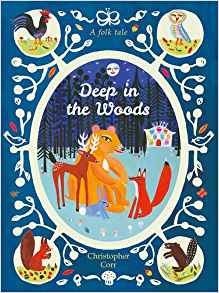
Q&A with Christopher Corr
Christopher Corr is the author and illustrator of the new children's picture book Deep in the Woods, based on a Russian folk tale. He is based in London.
Q:
Why did you decide to adapt this folk tale, and did you change it much from the
original?
A:
The book is based on a Russian story called “Teremok,” a word which is quite
difficult to directly translate but it
means a “cosy home in the forest.”
There
are lots of versions of it in Russian but I decided to keep to a simple
nature-loving tale about how friendship and cooperation can make for great and
wonderful things and even disasters can be overcome.
Q:
Did you write the text before you drew the illustrations, or vice versa?
A:
To begin with I wrote a brief synopsis of the story with some small sketches
and then I started to visualise the book. I wanted the words and the pictures
to be equally powerful and the colours I used to be joyful and moving … a tall
order!
Q:
What do you hope young readers take away from the story?
A:
The central message of the story concerns the importance of friendship and
support through the good and the bad times. Cooperation is so much better than
conflict. Respect for nature is there too in the book. We must all respect
nature.
Q:
How did you come up with your style as an artist?
A:
I travel a lot to paint and draw and I’m curious and fascinated by the world. I
look at a lot of primitive and folk art for inspiration. The
similarities and differences among people is wonderful and astonishing at the
same time. You don’t need words to communicate.
I
draw a lot on location, in the streets and in landscapes and I meet a lot of
people. My love for colour came from travelling in India. It was overwhelming
and amazing and so beautiful. I try to bring into my work elements that I have
seen on my travels.
Q:
What are you working on now?
A:
I’m currently working on the story of the Chinese Zodiac. It’s
a wonderful story with lots of animals and great Chinese landscapes. It will be
published in January 2018 by Frances Lincoln Books.
Q:
Anything else we should know?
A:
It’s a wonderful world! Colour is astonishing. There are so many fascinating
stories to be told from all over the world and they can teach us so much. I
want to keep exploring and finding old stories to retell.
--Interview with Deborah Kalb
Q&A with Jennifer Ryan
Jennifer Ryan is the author of the new novel The Chilbury Ladies' Choir. She has worked as a nonfiction book editor. Originally from the U.K., she now lives in the Washington, D.C., area.
Q: You write that some of the inspiration for the book came
from your grandmother's stories about World War II. How much was drawn from her
experiences and how much from your own imagination?
A: I like to think of historical fiction as the coming
together of all the different threads of experience, from the tales told by
my grandmother to the hundreds of books I read about the Second World War,
all condensed into a general understanding in my mind in which I could let my
imagination run free.
Some of the plot lines in the novel came directly from
my grandmother, such as the choir and the parties, and others came from some of
the old ladies I interviewed, such as the Women's Voluntary Service, the baby
swap, and how everyone kept morale up with jokes and singing.
The memoirs and journals provided a lot of the atmosphere,
of how it would have been like to live in a war situation, as well as the
consensus about the status of women, sexuality, the upper classes, and
homosexuality.
When I began to create Chilbury, I wanted to write a story
that could have really happened, and it was important to me that all of the
stories came from similar situations that I'd come across in people's stories
or in my research.
After that it was a case of creating the characters
and piecing all the different threads together.
Q: Did you need to do a great deal of research to recreate
England in 1940?
A: I must have read over a hundred books, mostly memoirs and
journals, and did copious research on the Internet, where the BBC has a
cache of personal stories.
When I grew up in the 1970s, the war didn't feel so
very long ago, and people talked about it a lot, which gave me a very good
basis for the period.
There were still remnants of the war, such as concrete air
raid shelters in the parks, and knocked-down buildings, especially in London.
Food rationing didn't end until 1954, and everyone was still a bit OCD about
using teabags twice and food wastage of any kind.
All of these things informed my research and my writing, and
helped me conjure up the time.
Q: Did you know how the story would end before you started
writing it, or did you make many changes along the way?
A: No, I didn't know how it was going to end. I think the
best way to write a novel is to create a situation with some really good
characters and just let them go and see where it takes you.
I had a few central moments that I thought might happen, but
otherwise it happened very organically. I must confess that by the end I was
rather surprised that it all tied up so nicely.
There were a few changes after the first draft, one of the
largest being an additional character: Miss Paltry.
After reading the first draft, I felt the need for a
different kind of energy in the book, and remembered a short story I'd written
a few years before, which basically followed the same plot line. I think
that was one of the decisions that really made the book work.
Q: What are you working on now?
A: I have started a new book, which is also set in the
Second World War but isn’t that all that similar to The Chilbury Ladies’ Choir.
It is, however, about women again, as I love to see how much
they evolved through the war, being given new freedoms and interesting jobs,
having more control over their lives, and of course facing the horrific
realities of war. They have such spirit and energy, not to mention their
wonderful voices.
Many people want to know if there’ll be a sequel to The
Chilbury Ladies’ Choir, and I would love to write one, so maybe in the future.
Q: Anything else we should know?
A: I'd like to leave you with a quote from the book, a
coming-of-age moment for one of the central characters, facing the war and the
different conundrums that it presents.
"And I realized that this is what it’s like to be an
adult, learning to pick from a lot of bad choices and do the best you can with
that dreadful compromise. Learning to smile, to put your best foot forward,
when the world around you seems to have collapsed in its entirety, become a
place of isolation, a sepia photograph of its former illusion."
--Interview with Deborah Kalb
Sunday, March 26, 2017
Q&A with Tilar J. Mazzeo
Tilar J. Mazzeo is the author of the new book Irena's Children: A True Story of Courage, also available in a young readers edition. The book focuses on the life of Irena Sendler, who rescued thousands of Jewish children during World War II. Mazzeo's other books include The Widow Cliquot and The Secret of Chanel No. 5, and her work has appeared in a variety of publications, including Food & Wine. She is the Clara C. Piper Associate Professor of English at Colby College, and she lives in Maine, New York City, and British Columbia.
Q: Why did you decide to write a biography of Irena Sendler,
and how did you research her life?
A: I'm particularly interested in writing about people who,
confronted with adversity, do something unexpected. And I'm particularly
interested in stories about women who break the mold, so Irena Sendler was a
natural fit when I first heard about her and the women in her network.
I researched her life using the autobiographical materials
she left behind in archives in Poland, as well as by talking to a number of the
children she helped to save, their families, and the children of the other
women in her network.
Q: You write, “In her native Poland, Irena Sendler is a
heroine today, although this is a relatively recent postcommunist development.”
How well known was she in the decades following World War II, and what were the
factors leading to her eventually becoming viewed as a heroine?
A: Well, she was well known to the Soviet intelligence
services, which was not a great thing for Irena Sendler or her family. She was
in a very difficult and often dangerous situation after the war ended because
much of her work after 1943 was funded by the American and British Jewish
communities with the help of the Polish Home Army.
As a result, when the Soviets took control of Poland after
1945, she and those who had worked with her were largely branded Western
dissidents. For this reason, Irena Sendler did not talk about her wartime
experiences and neither did any of the others involved. It was simply too
dangerous.
That meant that these stories didn't start coming out in any
significant way until the end of the Cold War, by which time many of those
involved had already passed away.
Irena Sendler and her network were, however, known in Israel
and among the Jewish community. She was awarded status as Righteous Among the
Nations in Israel long before the Cold War ended, in recognition of her moral
courage. But the Soviets denied her the passport to go to Jerusalem to accept
that award.
Q: In the book, you describe the incredible risks she took
to save Jewish children during the Holocaust. What motivated her to take the
actions she did?
A: I think she was simply a person with an astonishing
resolute moral compass. She and her friends were largely social workers and had
been committed to social justice for years in their work.
Faced with the realities of the Warsaw ghetto, they acted
because they believed it was right.
They risked their lives and the lives of their own families
in the process, and Irena Sendler always insisted that she was not a hero. She
insisted that she did what anyone of conscience would do. But, of course, what
these women did was, in fact, exceptional.
Q: What is her legacy today?
A: Since the end of the Cold War, Irena Sendler has become
increasingly well known and honored. There are schools across Poland and
Germany named after her, and she was decorated--despite her resistance to that
label--as a hero.
But her real legacy is the story of how a group of
"average" people, confronted with something they knew to be wrong,
quietly worked for justice.
If you visit her grave today in Warsaw, people who hear her
story light candles there, and I think the best image of her legacy for me is
that fact there is always something flickering. It's the kind of quiet tribute
that I think Irena Sendler would have most appreciated.
Q: What are you working on now?
A: I'm finishing a biography of another resolute woman,
Eliza Hamilton. There has never been a full-length biography of her, and most
people don't realize that, after Alexander Hamilton's death in the duel with
Aaron Burr, Eliza Hamilton lived decades longer and went on to co-found the first
orphanage in New York City. That orphanage still exists today.
--Interview with Deborah Kalb
Q&A with Arjun Singh
Arjun Singh is the author of Desert Teacher, which describes his life and his experiences working as a teacher in rural India.
Q: Why did you decide to write this book about your
experiences, and how did you choose the topics you wrote about?
A: There are three basic reasons. First, in 2009 I got the opportunity
to visit New York. I stayed there for three weeks. It was a turning point in my
life. I experienced that life was so
different there. It was a different planet for me with so many differences in
every aspect of life, like living style, food, civic sense etc.
During my stay in the U.S.A., whenever I was at an airport, a
railway station or a restaurant, I found most people reading books. At that
time I thought that books are the best medium to reach people, and if my book
is published on an international stage, then I would be able to share my
experiences with people abroad. But at the time I had no idea how challenging book
promotion is.
Since my school days, I was against dogmatic beliefs and
rude traditions like child marriages, the widow system, the death feast, the
untouchables, etc. But it was tough to break opinions that had been held for
generations.
During my college days I supported my widowed aunt to find a
job, and later when I wrote the story "My Widowed Aunt," based on life of my aunt, that got published in a magazine in Hong Kong.
I was very confident that people would definitely read my
stories and readers’ comments would be a moral support for me to fight against the
rude system in society.
Most of the stories in my book are related to traditions,
and in almost every story it is described how a perfect balance can be made
between traditions and modernization. In my opinion, an educated person can do
this, and life is more comfortable and happier.
Second, Jaisalmer, my town, is popular among tourists all
over the world. Nicknamed “Golden City,” it is famous for its prestigious
history and unique beauty.
Thousands of tourists come to Jaisalmer every year and they
are amused to see the architecture of historical monuments like forts, palaces,
temples, havelis, etc., but at the same time they are more interested in
culture and life.
But there is no written information available. To respond to
their curiosity, I thought that my book would be a good medium to answer some
questions related to the life of my town.
Third, one who dares to teach must never cease to learn….so
as a teacher I learn everyday and want my students to know that education opens
windows to the world. To set an example among my students, I decided to publish
my stories on an international stage. I wanted to prove to my students that education
matters and my book is the best result of it.
I chose "Desert Teacher"as the title of the book because it’s
a collection of stories about life in the Thar Desert of Western India by a
teacher.
Q: As you’ve explained, you’re a teacher, and some of the
chapters deal with your experiences in the classroom. What do you see as your
role in the community?
A: The role of a teacher in the community is most important.
I have been teaching in a rural area for 18 years and I personally feel that a
teacher plays a prominent role in a community where literacy rate is very low.
In the present, everyone fights for rights and very few
fulfill their duties. So as a teacher my job is to educate kids so they could
understand their duties for their community and country. Although I got chances
to be posted in the city, I think my duty is to promote education in a rural
area and it is much needed.
Q: What do you hope readers take away from the book?
A: I want my readers to know that my stories clarify that
India is evolving, especially rural India. There is a lovely thread of opening
to new ideas, generations by generations, that my family represents in my
stories. I hope my readers will enjoy these short stories, written in simple
English, about every aspect of life in the desert.
Most of the characters are from my family and even they have
no idea that what they think is very normal in their life can be so unusual and
interesting for many people.
Readers will not only come to know about the struggles of
life in the desert but also understand how the people of the most typical and
dry area deal with and intelligently solve their problems. It’s a journey from darkness to light.
--Interview with Deborah Kalb
Subscribe to:
Posts (Atom)