
ON THIS DAY IN HISTORY
Jan. 4, 1943: Doris Kearns Goodwin born.

Sudhir Hazareesingh is the author of the new book Black Spartacus: The Epic Life of Toussaint Louverture, a biography of the 18th century Haitian leader. Hazareesingh is a fellow and tutor in politics at Balliol College, Oxford.
Q: Why did you decide to write a biography of Toussaint Louverture?
A: I have always been interested in two things: the revolutionary tradition which comes out of the French Revolution of 1789, and the role of strong leaders in politics – hence my books on figures such as Napoleon Bonaparte and Charles de Gaulle.
When I came across Toussaint Louverture it became clear that he was the obvious choice for me: he was one of the most remarkable leaders to emerge in the late Enlightenment Atlantic world, and he led the people of Saint-Domingue in their fight to free themselves from slavery and imperial domination.
It was largely thanks to him that Haiti, the world’s first independent black post-colonial state, came into being in 1804.

Q: What would you say are some of the most common perceptions and misperceptions of him?
A: His admirers and enemies alike have often portrayed him as one-dimensional. What is most fascinating about him is his complexity – he was shaped by multiple intellectual and cultural influences, from Europe, Africa, and the Caribbean, and they often pulled him in different, and at times conflicting directions.
But his cardinal principles, to which he remained true until his death, were very clear: he sought to protect his people from enslavement, create a political system which defended the sovereignty of Saint-Domingue, and build a multi-racial community in which whites, black and mixed-race people could live in harmony.
Q: In a review in The Guardian, David A. Bell says, "The story [of Toussaint Louverture's life] is astonishing – but also astonishingly difficult to write about." Was this a difficult book to research and write?
A: Toussaint’s actions and intentions are still very contentious, and establishing his true motivations was not always easy. He left behind a significant paper trail but his archives are scattered across different countries (France, Spain, Britain, the United States) and pulling all this material together was not simple.
And there are (as always) significant gaps in the sources – we have few documents relating to the early and middle decades of Toussaint’s life, when he was enslaved on a sugar plantation; and all his letters to his mistresses were burnt by the French when they invaded Saint-Domingue in 1802.
Q: What do you see as Toussaint Louverture's legacy today?
A: Toussaint championed the rights of black people throughout his life, and so he is one of the symbolic historic patrons of the Black Lives Matter movement, which focuses on the principles of black dignity and equality.
He is also someone who stood for forgiveness, compassion, and reconciliation, and for a politics which seeks to bring people together on the basis of their shared interests and values, and appeals to their common humanity. These are all powerful and relevant messages for our polarised times.
Q: What are you working on now?
A: I am taking a little breather: working on Toussaint was very intense! But I very much want to continue to carry out more research in the general area of French colonialism, and in particular how colonial peoples actively resisted French imperial rule.
Q: Anything else we should know?
A: I just found out that Black Spartacus is one of the books longlisted for the 2021 Jacqueline Bograd Weld Award for Biography, which is one of the annual PEN America Literary Awards. I am greatly honored and immensely grateful to the judges!
--Interview with Deborah Kalb. Here's a previous Q&A with Sudhir Hazareesingh.

Jeannine Ouellette is the author of the new memoir The Part That Burns. She is the founder and director of Elephant Rock, a creative writing program in Minneapolis.
Q: Why did you decide to write this memoir?
A: To be honest, I didn’t really decide to write it—I simply had to write it, to come to terms and make peace with certain elements of my past, especially my childhood and adolescence. In many ways, I have been writing this book, or trying to write it, all of my life.
In the book—in the second to last chapter, which I wrote with my daughter, Lillie—the narrator says, “In psychology, the life story model says people in modern societies provide their lives with unity and purpose by constructing internal and evolving narratives of the self. This model explains that identity takes the form of a story, complete with settings, scene, character, plot, and theme.”
And that’s essentially what I was doing through writing this book: examining my own life, and interrogating some of the narratives that have defined it.
In doing that, I have inevitably transformed my relationship to those narratives, and, in turn, transformed my understanding of myself and my identity. I feel, too, that I have gained greater understanding of many of the other people in my life, and greater empathy for them.
I was also eager to understand and illuminate how the visceral experiences of pregnancy, birth, and breastfeeding were so pivotal in my regaining the ability to “live in my body” rather than hover above or beside it. And mothering—the experience of loving my children deeply—was pivotal as well, in the way it taught me how to see myself as lovable, too.

Additionally, of course, I wrote the book hoping that it would offer something to people who carry their own traumas. I hope it offers a testament to the power and possibility of resilience, healing, and love. That’s what Dorothy Allison’s Bastard Out of Carolina did for me back when I was in my 20s, and I’d love for my book to do that for someone else now.
Q: What impact did writing the book have on you?
A: Although writing about childhood sexual abuse was painful, it was healing, and often joyful, which may surprise people. It certainly surprised me.
In fact, until The Part That Burns, I had never been able to successfully capture, in any kind of artistic way, my childhood experiences on the page. If I have done that now—if I have made art from life—it is because the methods I used to approach the writing were often very playful, especially for the most difficult vignettes.
The techniques I used were drawn from an approach I learned from a mentor named Paul Matthews, author of the creative writing sourcebook Sing Me the Creation. Back in 2009 or so I attended a three-week workshop with Paul where I learned how to use writing constraints, which were new to me at the time.
I had been writing for more than 20 years by then, but had always written with fairly conventional methods—starting with an idea, building a scene around that as an entry point, building some momentum on the page, amassing a certain amount of material, then finally shaping it iteratively until I had an essay or a story.
But writing constraints work differently. Constraints are like puzzles, and those who are interested in experimenting with constraints can find a lot of helpful resources on the internet, as always.
The most famous reference for the use of writing constraints is probably the Oulipo, a group of mainly French-speaking writers and mathematicians who, since the 1960s, have gathered to develop and use constrained writing techniques to catalyze creativity.
The way Paul Matthews taught with writing constraints was just zany and wonderful and incredibly freeing, and it opened up a whole new world for me in terms of my writing life.
For me, the bonus is that writing constraints also ended up making it far safer, emotionally, to take on some of this old trauma. I wrote about that for my graduating lecture during my MFA program, and I’ve written craft essays about this topic as well, like this one, From Play to Peril, in Cleaver Magazine.
Q: How did you choose the book's title, and what does it signify for you?
A: I love that question because the title means a lot to me. Twice in the book, the narrator uses that phrase, the part that burns.
Once the narrator says it—well, she thinks it—while she’s meeting with her therapist. She is pregnant with her second child, and having a lot of flashbacks of her stepfather’s abuse, and she is suffering a great deal.
And then she has recently read something about cellular memory, which is about how we carry all of our experiences in our cells forever, which is making her terrified that she will always be harmed or controlled in some way by her stepfather’s molestation.
And as she is pondering this, she thinks to herself, “When I’m fiery and floating, I watch myself from above. My body is not me. I am the part that burns.” What she is describing is a sort of disassociation from her physical body.
But, later, just after giving birth to her son, which is a healing, embodying experience for her, she says, “This boy is neither flower nor weed. He doesn’t come from the earth. He comes from me. The part that burns is the part that glows.” So that phrase, the part that burns is the part that glows is like a recognition that every part of us is acceptable and lovable, even the wounds. And that sometimes, maybe quite often, the wounds can hold light, as well.
Q: Can you say more about what you hope readers take away from the book?
A: Well, I hope they take away some of that lightness and a lot of hope—despite that there is heaviness in the book—because there is also resilience, forgiveness, and a great deal of love.
I hope they find reassurance that even when life is painful and messy, it can lead us to essential places, places where we are able to become our fullest, most whole selves.
At one point in the book the narrator says, “It takes so long to become anything. Especially yourself.” And I really believe that—that we are always in this process of becoming. We are human beings, and that’s a verb. We’re evolving always, or should be.
Sometimes that means letting go of old ideas of who we are. Sometimes it means circling back to experiences we thought were behind us, but really are not, because, as Einstein tells us, past, present, and future are just an illusion. Everything is now.
Which is hard on the one hand, because it means nothing is every truly “behind us.” There’s no such thing. But it’s wonderful, too, because it means we have chance after chance to reorganize our understanding of our experiences and of who we are, and who we want to be. For me, that’s part of what cellular memory and epigenetics are all about. I find it wonderfully hopeful.
Q: What are you working on now?
A: I’m working on a few things, including a lot of flash fiction pieces which maybe could at some point form a collection. But I’m also working on a novel, and all of that feels really good, to be writing fiction again!
Q: Anything else we should know?
A: That it’s scary to share the truest version of who you think you are. But no one should feel as if they have to keep secrets or stay silent about their lives—maybe especially about childhood sexual abuse, because the secrecy and silence around that is so incredibly destructive. For some of us, creating a narrative of our lives is the surest path to healing.
That doesn’t mean it’s not scary though. The first time I ever told someone what my stepfather did to me, I was a teenager, and my stepmother at the time recoiled from me as if I was dirty or dangerous, which I write about briefly in the book.
It was intensely painful to be treated that way. For a very long time, her shaming reaction stopped me from being able to talk again about what had happened to me. It took me decades to reclaim my voice.
So, for anyone out there who is afraid, I just want them to know I understand. I know what that fear feels like. I feel it still. And it’s okay to be afraid. But it’s also okay to tell your story, if you need to, and are able to safely. I wish for that—safety and healing—for everyone.
--Interview with Deborah Kalb

Srianthi Perera is the author of the new novel A Maiden's Prayer. A journalist, she has worked in Sri Lanka, Oman, Canada, and the United States.
Q: How did you come up with the idea for A Maiden's Prayer, and for your cast of characters?
A: Years ago, I attended a fiction writing program where I was asked to write about something I know and bring it to class. Since I grew up in Sri Lanka, it wasn’t difficult to find an experience that would be foreign to most Americans. I created my character Tamara de Silva and, during the progression of the class, followed her coming of age.
In class, when I read aloud each portion of my tale, I found that the other participants were very attentive and interested in my material. Also, the instructor was most encouraging, and posted the first chapter in an online magazine he was editing.
That was the beginning of it. After the class concluded, I developed the story further and made Tamara narrate her uncle’s story and made it much more than her adolescent experiences. I wove in subplots that necessitated creating various characters, drawing and symbolizing from the vast resources of my culture and country.
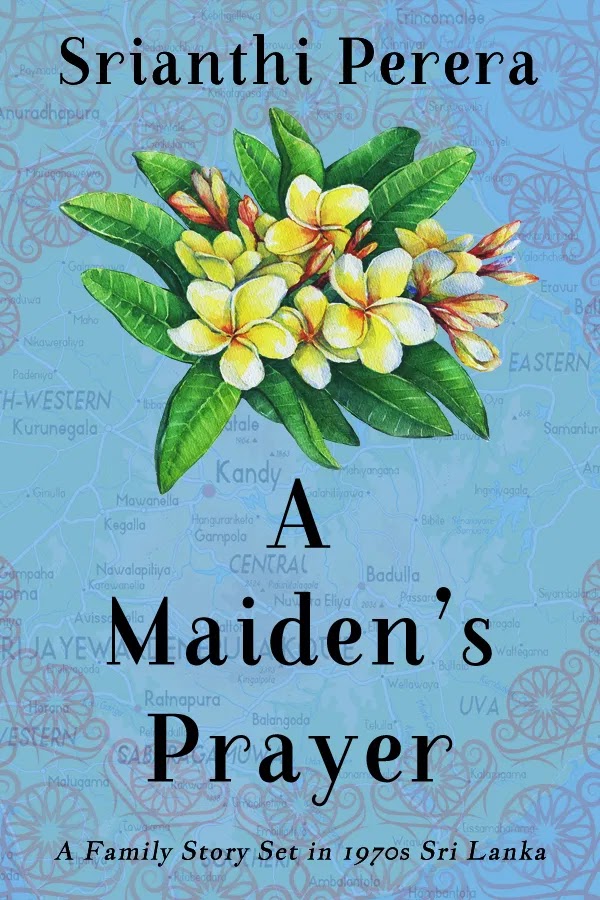
Q: The novel is set in Sri Lanka in the 1970s--did you need to do much research to write the book, and how important is setting to you in your writing?
A: I grew up there in the 1970s, hence that time period, from 1973-77 isn’t
strange to me. I wish I had taken notes at the time, but of course, I didn’t.
Therefore, I had to pore over archived newspapers to remind myself of various
little details, and to validate the political events and social happenings that
I portray.
Although this is a work of fiction, the story is rooted in reality. I wanted the setting and description to be accurate and immediate. I don’t use too much literary license, probably because of my background in journalism. In fiction, setting helps create nostalgia and maintains a story’s sincerity.
Q: Did you know how the book would end before you started writing it, or did
you make many changes along the way?
A: Even when I was halfway into the story, I didn’t know how the book would end
because I had two probable endings and I tussled with them for a long time. I
felt the ending I chose is more poignant than the other option I had
considered.
Q: What do you hope readers take away from the story?
A: In a nutshell, an entertaining and educational experience. To Americans, my
story is an intimate glimpse into a little-known foreign culture. It is
suitable for readers of literary fiction who are curious about other
ethnicities, while history lovers would appreciate the accurate representation,
along with the political backdrop.
Many themes run through the story, such as Vedic astrology, which played a salient part in the society; the underpinnings of Buddhism; the lingering influence of British colonialism; the sad and detrimental effects of alcoholism on a family; and the unique customs and social norms of the day. Sri Lankans would be nostalgic, while other Asians would be reminded of their own similar cultures.
Q: What are you working on now?
A: From fiction to creative nonfiction: I’m working on a book of short stories
based on my extensive travels and experience of living in four
countries: Sri Lanka, the Sultanate of Oman, Canada, and the U.S.
Q: Anything else we should know?
A: The rituals and norms of 1970s Sri Lanka have changed. Puberty rituals are
not followed, especially in the cities. Love marriages are more common
than arranged marriages, and there’s less reliance on astrology for a
successful life. In that sense, A Maiden’s Prayer is a time
capsule.
--Interview with Deborah Kalb
 |
| Photo by Nina Subin |
Jennifer Blecher is the author of Stick with Me, a new middle grade novel for kids. She also has written the middle grade novel Out of Place. She lives in Massachusetts.
Q: How did you come up with the idea for Stick with Me, and for your characters Izzy and Wren?
A: I wanted to write about two girls who were thrown together for a short period of time under unusual circumstances. I wanted the girls to be different, but also more similar than they realized. I had an image of one girl in a bedroom and the other looking up at her from the street. The story grew from there.
Q: Did you know how the novel would end before you started writing it, or did you make many changes along the way?
A: I made so many changes along the way! When I started writing I had a vague sense of how the story would end. As I got to know Izzy and Wren better, the plot of the ending changed but the spirit remained the same.
Q: What do you hope kids take away from the story?

A: That friendship is complicated. But sometimes a friend will come into your life for just a short period of time and be exactly what you need.
Q: Which authors do you especially admire?
A: Rebecca Stead, Ali Benjamin, Janae Marks, Lauren Wolk, Kimberly Brubaker Bradley, Jacqueline Woodson and so many more!
Q: What are you working on now?
A: A middle grade novel that I'm really excited to share. That's all I can say for now!
Q: Anything else we should know?
A: The opportunity to write novels for this age group is a huge privilege. I'm enormously grateful to my readers and the team of people who make these books possible.
--Interview with Deborah Kalb


